CRA Platform: conformity evidence for every release
For companies that make, import or sell products with digital elements in the EU.
Full application of the CRA: 11 December 2027 — in 400 days. Vulnerability reporting has applied since 11 September 2026.
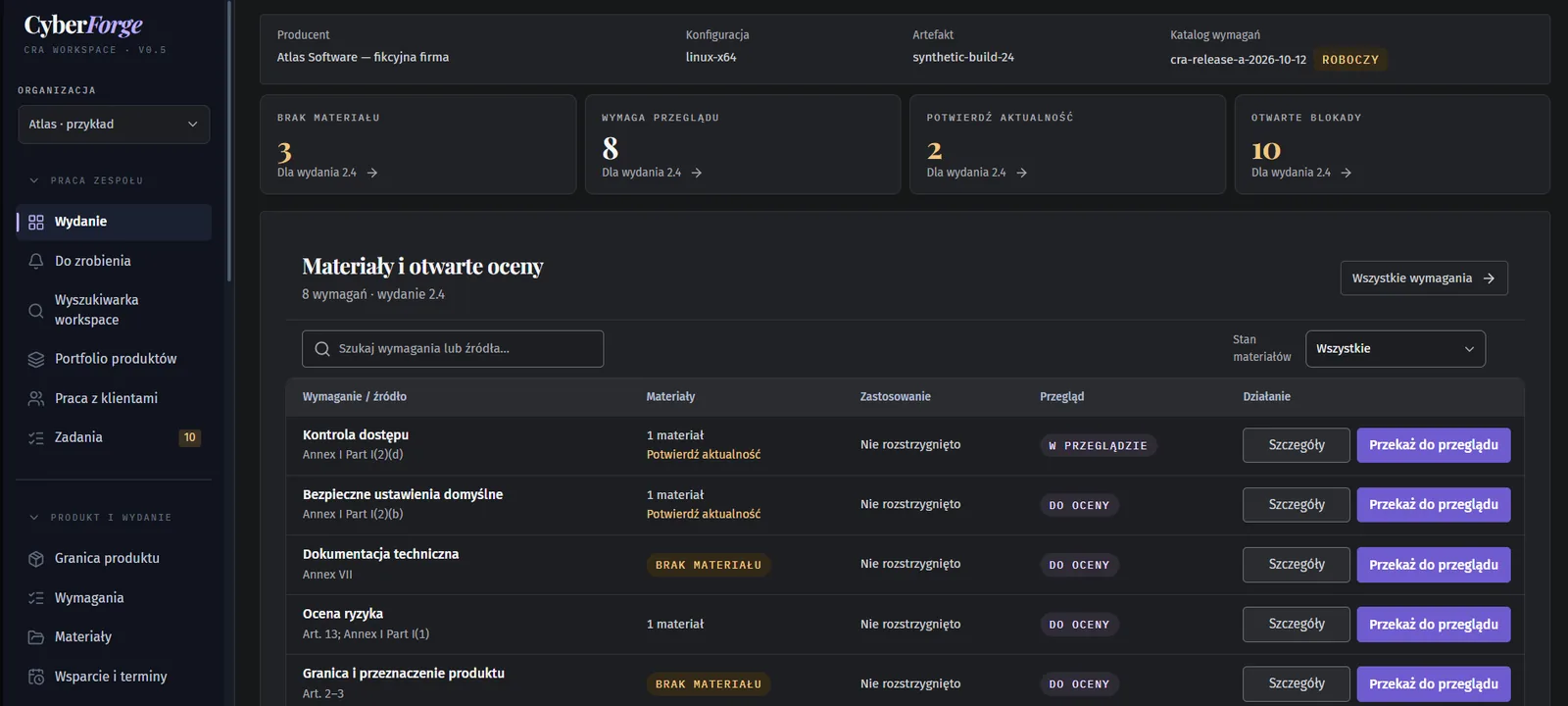
Documents the platform assembles for you
Technical documentation must stay available for ten years — or for the whole support period, if it runs longer. The platform assembles it from records that passed review — not from an empty template the week before an audit.
Annex VII — technical documentationProduct description, design and manufacture, risk assessment, support period, standards, test reports. Every section names the record it came from.
Annex II — instructions and informationProduct identification, intended use and risks, the contact point for reporting vulnerabilities, support and decommissioning.
Draft declaration — Annex V/VIManufacturer details, scope of the declaration, the statement to be signed, the signatory and the limitations — ready for your signature.
Auditor evidence packageAn export of scope, materials and decisions for one version, with a checksum manifest for every file and an optional digital signature — the auditor can verify nothing changed after export.
Vulnerability advisory in CSAF 2.0The machine-readable format your customers’ security teams expect, generated from the decisions actually recorded in the platform.
Exportable audit trailThe full history of actions in the organisation, downloadable as CSV — a ready answer to who made which decision, and when.
Documents are built from the data of a specific release. Empty sections show up at once as a list of gaps — you know what is missing before the auditor asks.
What the platform does
Counts reporting deadlines
From the moment you become aware of a vulnerability, it counts 24 h for the early warning, 72 h for the notification and the final-report deadline: 14 days for a vulnerability, one month for an incident. Every deadline has an owner and a deputy.
Takes reports from researchers
Provides a public reporting form, anonymous submissions included. It acknowledges receipt and scans attachments for malware before anyone opens them.
Runs reporting drills
Runs a scenario on test data, from the moment of awareness to the report content. Nothing reaches an authority.
Prepares report drafts
Assembles a draft report for every stage and shows where each field comes from. Records submitted reports with receipt confirmation. You submit to the ENISA platform yourselves.
Keeps an Annex I requirements map
Gives every requirement a status for your product. It asks for a justification when a requirement does not apply, and does not allow vulnerability-handling requirements to be marked that way.
Suggests a start by product type
Has profiles for a library or SDK, a SaaS service, an IoT device, an operating system, a router, a VPN and a microcontroller. A profile suggests requirements and risks; your team decides.
Versions the risk assessment
Links every threat to a safeguard and the test that confirms it. When product facts change, it sends the assessment back for review.
Turns gaps into tasks
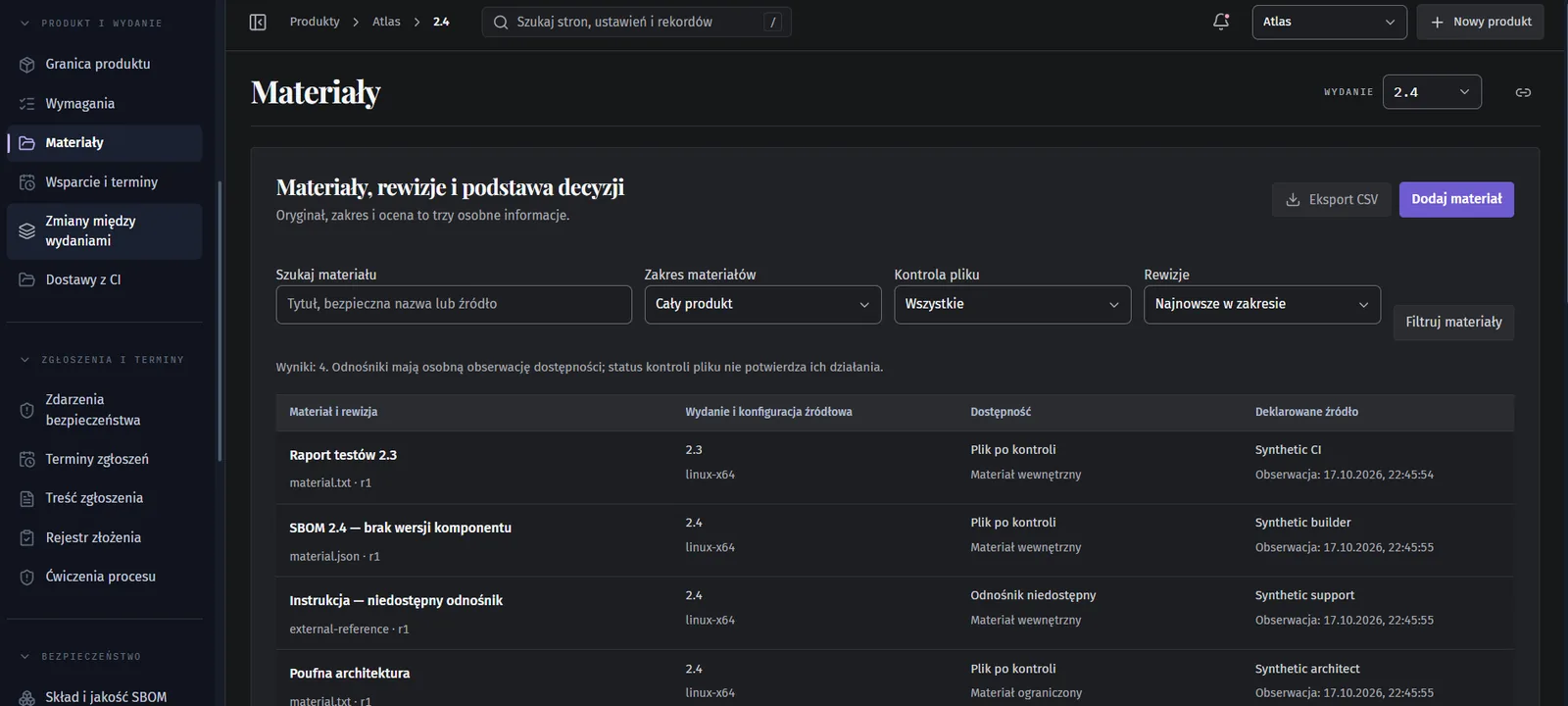
A missing or outdated material becomes a task with an owner and a due date.
Requires a reviewer’s decision
Adding a material is not acceptance. A reviewer approves each release separately, and that decision does not carry over to the next version on its own.
Tracks regulatory changes
Sends the updated requirements to review and to a re-assessment queue. It does not change earlier decisions, packages or deadlines.
Takes the SBOM of every release
Imports CycloneDX JSON 1.4–1.7 and SPDX JSON 2.3. On import it checks PURL identifiers, licences and dependencies.
Matches vulnerabilities to versions
Pulls data from OSV.dev automatically and flags the releases a vulnerability may affect. It records your impact assessment and remediation decision.
Imports scanner results and checks licences
Accepts results from Trivy and in SARIF format. It checks licences against a policy approved by your reviewer — a technical result, not a legal opinion.
Shows shared components
Points out components that recur across several products and records the decision for each product separately.
Receives SBOMs from the pipeline
Ready templates for GitHub Actions, Jenkins and GitLab CI: the SBOM is built in the pipeline and delivered on every release. The key works for a single release only, so a pipeline leak does not expose the rest of your data.
Blocks an unchecked release
Your pipeline asks the platform for the review status. If the review is missing or materials are outdated, the build fails.
Connects to your team’s tools
Sends review status to pull requests on GitHub and GitLab, creates tasks in Linear and sends notifications to Slack or via a signed webhook.
Shares a release with your auditor
Gives an auditor or customer limited access to a single release. The auditor asks questions in the platform, and access expires or you revoke it at any time.
Keeps the history of every release
Pins materials, documents and vulnerabilities to a specific version, so any release can be reconstructed later.
Enforces retention
Keeps data for the declared support period. It suspends deletion during a dispute or inspection, and deleting data requires two approvals.
Handles many clients
For consultants and integrators: a separate work queue for each client and question templates. Client data never mixes.
Teaches inside the app
Includes articles, a glossary, module manuals and lessons with exercises. For now they — and the whole interface — are in Polish.
What changed between releases
An audit does not ask about today’s state; it asks what changed and on what basis. Without a comparison, every release has to be proven from scratch.
Comparison of two releasesScope, requirements, materials and decisions of the old and the new version side by side. You see what was added, what disappeared and what was carried over without review.
Exploitability statementsVEX records with a trace of every state change: since when, on what basis and who decided that a vulnerability does not affect this release.
Remediation trackingPriority from severity, exposure and support, an assigned owner, and closure only after the fix is verified against a specific artefact.
Supplier queriesThe query sent, the answer received, the review and the acceptance — a register for when someone asks where a part of the product came from.
Duties and records by role
Each role carries different CRA obligations. You keep them tied to a specific release.
Manufacturer
Makes the product and is responsible for its conformity.
Product boundary and role
Functions, update mechanism, connectivity and supply-chain role.
What every release contains
SBOMs and documents kept separately for each version.
A decision on every vulnerability
Impact assessment, fix or justification, and who decided.
Documentation from records
Annex VII and the declaration of conformity, with gaps visible at once.
Available for 10 years
A full activity trail and package export on an authority’s request.
Importer
Places a product from outside the Union on the EU market.
Register of products and manufacturers
What you place on the market, from whom and in which version.
Evidence from the manufacturer
Conformity assessment, technical documentation and the EU declaration.
Check before placing on the market
Date, person and outcome of the check.
Reported non-conformities
What you passed to the manufacturer and authorities, and when.
Documentation on request
For the required period, with access control.
Distributor
Makes the product available further on the EU market.
Register of products made available
Where the product comes from and which release it relates to.
CE marking and documents
Checked before making it available, not after a complaint.
Record of the check
That the manufacturer and importer met their obligations.
Response to non-conformity
Stopping sales and informing the manufacturer.
Cooperation with authorities
Correspondence and material provided on request.
A safe place for your evidence
Your customer's security team will ask these questions during vendor assessment. The answers are ready, and we will walk through the technical detail on a call.
Tenant separation at the database level
Each organisation's data is separated inside the database itself, and the application has no permission to bypass it. A bug in the code does not open another customer's data — the database blocks it.
Roles and separated permissions
Admin, contributor, reviewer, reader. Recording and approving are two distinct capabilities, granted independently and per product.
Multi-factor authentication
TOTP with secrets encrypted at rest, passwords hashed with bcrypt, login attempt throttling and a separate account recovery path.
Append-only history
A database trigger rejects any edit to a historical record. A correction becomes a new entry with its author and date, never an overwrite of the previous one.
Upload screening
Every material is scanned for malware before it enters the library. Document rendering runs in a separate, resource-bounded process.
Security headers and session protection
A CSP policy, CSRF protection, SameSite cookies and request limits on sign-in, the API and file uploads.